Inner / Journal
When Sound Becomes a Place
Exploring hypnagogic imagery, learned recognition cues, and the possibility of carrying awareness into sleep.
I. The Threshold
I’ve always been fascinated by the boundary between waking consciousness and sleep. Dreams themselves were fascinating, but the moments leading into them were especially intriguing. The strange transitions where thoughts begin to form images, when sounds take on unexpected meaning, and the moments when the familiar awareness of lying in bed can give way to an entirely different environment.
When I first began practicing lucid dreaming and exploring altered states of awareness, I struggled with something seemingly simple: staying conscious of the experience as I approached sleep. I would fall asleep too easily. I tried different positions. I tried different pillows. I tried different temperatures. Little by little, I began to find what worked for me, but still I found myself in a battle with sleep.
To bridge this, I developed simple phrases to repeat throughout my practice:
“Tonight awareness lies in me, tonight awareness lets me free.”
It wasn't a complicated technique; it was an intentional anchor. Over time, I noticed that the ambient sounds accompanying my practice weren't remaining in the background. They were beginning to weave into the fabric of the experience itself.
II. When Sound Becomes an Image
During earlier work with sound exercises, I noticed that certain sweeping, noise-like signals produced vivid imagery as I entered deeper threshold states.
One experience stayed with me: as a sound moved and swelled, I perceived an enormous grandfather clock pendulum swinging overhead. There was no clock in the room, nor was the audio a recording of one. Yet the acoustic movement acquired a clear visual form.
This sparked a core question: Could sound do more than create an atmosphere for meditation or sleep? Could it actively shape the imagery that emerges as waking awareness dissolves?
III. When an Image Becomes a Place
While developing and using Inner, I experienced this immersion vividly through an environment called Temple.
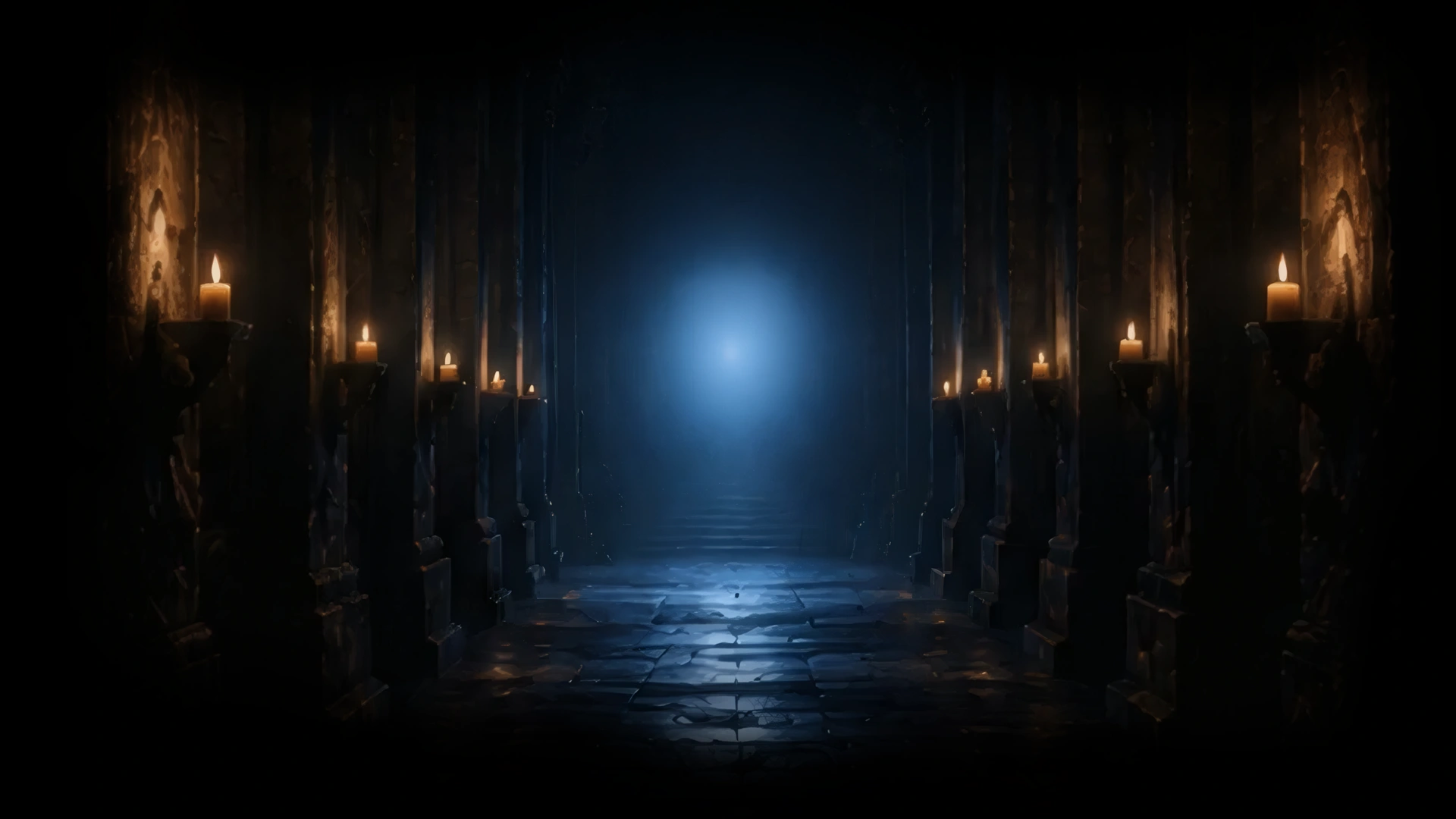
The audio of slow, echoing footsteps placed me inside a dark stone room. The room was damp, poorly lit, with cold air, and sounds reverberating against stone surfaces. At times, awareness of my physical bedroom disappeared entirely. My felt reality became the room itself. A distant aum sounded, followed by movement nearby. I found myself searching the space, thinking deliberately and reminding myself to stay aware. Yet, I didn't recognize that the environment was being generated by my own mind.
This distinction is crucial: I maintained a thread of awareness within the experience without recognizing the fundamental nature of the experience itself.
IV. Two Sounds, Two Responses
Within Inner’s Overnight Journeys, recognition cues are designed as auditory reminders of an intention to remain aware. Over time, I had associated these cues, drawn from guided experiences like Chambers and Guardians, with deliberate awareness. The ascending tone is an exception, as it wasn't drawn from those guided experiences.
However, using different cues within Temple revealed something interesting: the same environment could produce distinctly different responses depending on the recognition cue I used.
- The Narrative Sound (Guardian Signal): Combined with Temple, this cue sounded like something scurrying across the floor. Rather than reminding me I was dreaming, it drew me deeper into the narrative as I searched the room to see what moved.
- The Grounding Sound (Droplets Signal): This crisp, distinct sound broke through the atmospheric immersion. It reminded me that I was not physically in that stone room, prompting me to step back and question my state.
One sound encouraged investigation within the narrative; the other encouraged reconsideration of the reality itself.
V. Targeted Memory Reactivation: The Science of Association
These experiences raise questions that intersect with an area of sleep research known as Targeted Memory Reactivation (TMR).
In TMR studies, researchers pair specific sensory cues, such as sounds, with learned information during wakefulness, then replay those cues during sleep to evaluate memory processing (Carbone & Diekelmann, 2024). The underlying idea is that a sensory cue associated with prior learning may influence how that information is processed during sleep.
Research demonstrates that sleeping consciousness can sometimes process external information and respond intentionally, such as the 2021 Current Biology study demonstrating two-way communication during REM sleep (Konkoly et al., 2021). While these studies don't validate specific audio platforms, they suggest that sleeping consciousness is not always entirely disconnected from external information, and that meaningful responses can sometimes occur without fully waking.
VI. Designing for Recognition, Not Just Immersion
When building Inner, the natural impulse was to continuously expand with more environments, more soundscapes, and more content. But these experiences pointed toward a different design philosophy.
The goal isn't just to play audio overnight, nor is it merely to trigger lucid dreams. The goal is to establish a coherent, recurring loop between preparation, sleep, and reflection by asking more precise questions:
- Did you notice the cue?
- Did it assimilate into the environment or break through it?
- Did it prompt you to question whether you were awake or dreaming?
Instead of asking how many elaborate places we can build for the mind to visit, we should ask how we can carry awareness into those places as they emerge.
Research References & Notes
- Carbone, J., & Diekelmann, S. (2024). An update on recent advances in targeted memory reactivation during sleep. npj Science of Learning, 9, 31. https://doi.org/10.1038/s41539-024-00244-8
- Konkoly, K. R., et al. (2021). Real-time dialogue between experimenters and dreamers during REM sleep. Current Biology, 31(7), 1417–1427.e6. https://doi.org/10.1016/j.cub.2021.01.026
- Stumbrys, T., Erlacher, D., Schädlich, M., & Schredl, M. (2012). Induction of lucid dreams: A systematic review of evidence. Consciousness and Cognition, 21(3), 1456–1475. https://doi.org/10.1016/j.concog.2012.07.003