Inner Research Foundation
A Discovered Ecology for Lucid Awareness
Five presences. One living system. A complete framework for conscious dreaming — synthesized from fifty years of research and practice, built to deepen automatically with every session you put into it.
About the Book
Most approaches to lucid dreaming are about memory. You remember to check. You remember your intention. You remember that you're dreaming. The techniques are well-designed — but they share a structural vulnerability: the faculty they depend on is precisely the faculty that sleep dismantles. Memory degrades at the threshold. Effort dissolves.
The Guardian Ecology begins from a different premise. Rather than training the mind to remember, it trains felt awareness to recognize. Rather than installing intentions that must survive the crossing intact, it cultivates presences that operate independently of memory — somatic qualities of awareness that are already oriented to the threshold when the threshold arrives.
The five Guardians are not techniques in the conventional sense. They are cultivated aspects of your own awareness, each trained to a specific moment and a specific function in the inner journey. Together, when genuinely established, they form something more than a collection of tools: a living ecology that adapts to whatever territory you encounter, deepens automatically with each session, and eventually becomes less a practice you do than a ground you inhabit.
This manuscript draws from Stephen LaBerge's landmark laboratory research, Robert Monroe's phenomenological cartography of threshold consciousness, over a thousand years of Tibetan dream yoga practice, and contemporary neuroscience of metacognitive awareness, interoception, and sleep-dependent memory consolidation. What each tradition arrived at, independently, was a version of the same observation. This book formalizes that convergence into a learnable developmental sequence.
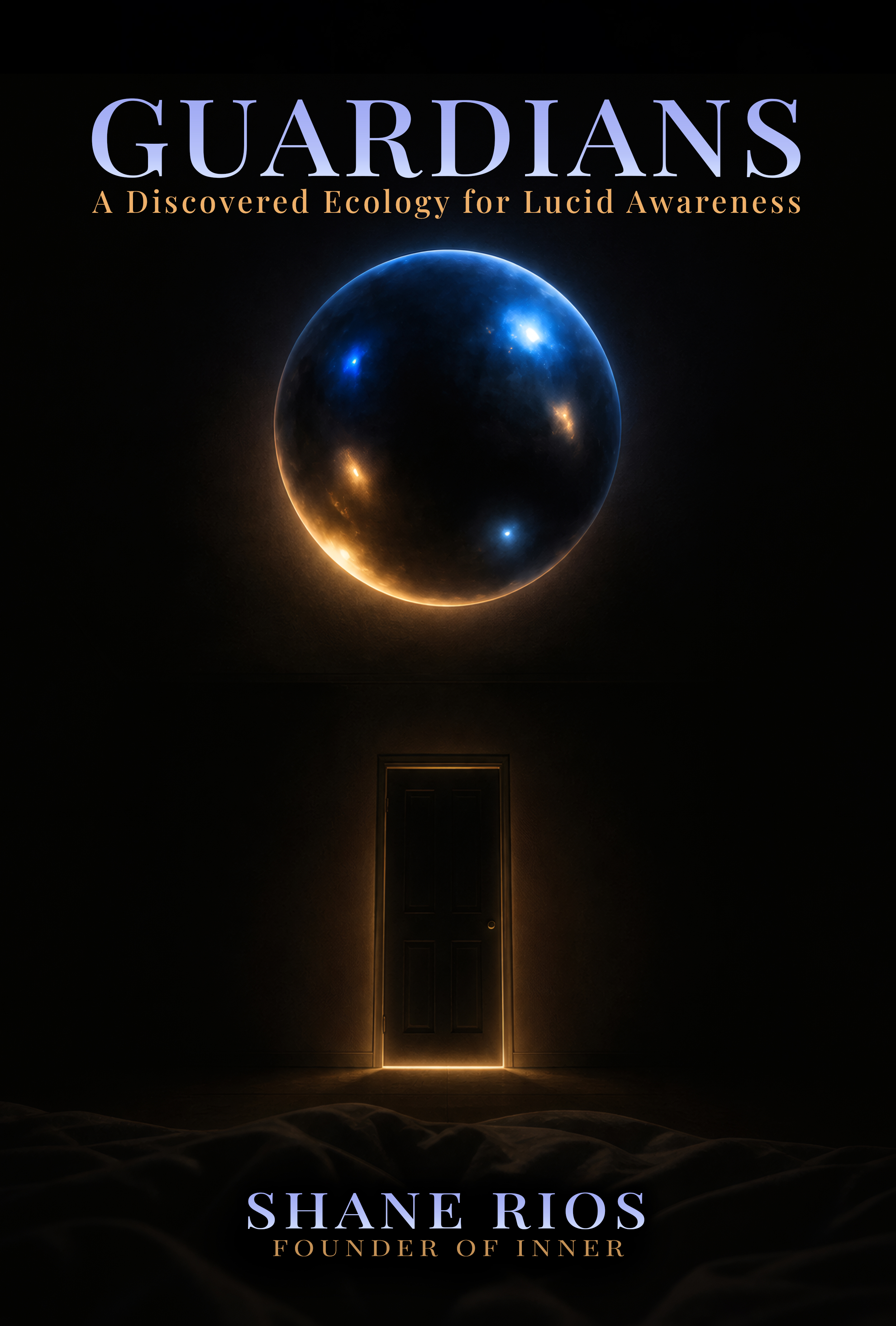
The Guardian Ecology
Each Guardian is a cultivated aspect of your own awareness, trained to a specific moment and function in the inner journey. They must be developed in sequence — what fails when practitioners attempt to bypass stages is well-documented in the text.
Guardian I
The metacognitive faculty that recognizes the dreaming state from within it. Not a remembered cue — a trained quality of awareness that signals its own presence. The foundation everything else depends on.
Guardian II
Once recognition occurs, the dream state must be held without destabilizing it. Stability is the somatic quality that maintains lucid presence — grounded, unrushed, continuous across the natural turbulence of dreaming.
Guardian III
The capacity to move from surface lucidity into deeper territory. Depth allows intentional descent — past the dream surface into states associated with insight, encounter, and the less-charted regions of inner experience.
Guardian IV
A cultivated quality of presence that navigates difficult, destabilizing, or confrontational dream content with equanimity. The ecology's safeguard — allowing the practitioner to go deeper without being undone by what they find there.
Guardian V
The ecology's most novel element. The Retroactive Guardian operates across time rather than within a single session — a field of accumulated practice that persists, deepens, and develops its own intelligence between sessions. The ground the other four come to inhabit.
The Practice Architecture
The book describes the complete ecology. Its audio system is being built progressively in Inner.
Cultivation
The primary 20–30 minute pre-sleep track is voice-led through Location, Dissolution, and Orientation.
Calibration
A shorter 5–10 minute waking practice reinforces the Guardian between full sessions.
Field
A minimal carrier track designed to play during sleep. It does not guide; the planted Guardian operates independently.
Available now: Guardian 1 — Recognition: Cultivation. The remaining Guardian tracks, including Calibration, Field, and the five-Guardian Collective, are in development.
Who This Is For
This manuscript is for practitioners who want to understand the complete Guardian Ecology: what each presence does, why the sequence matters, and how the system is intended to develop from Recognition through the Retroactive Guardian.
The book can be read alongside Guardian 1 — Recognition in Inner, and it also stands as the theoretical foundation for the audio practices still being developed. Understanding the full ecology gives practitioners a map of the territory before every track is available in the app.
If that describes you, this is the book.