
01 The Moment of Waking
Stay with the dream before you reach for the day.
If you cannot remember it, you cannot work with it, and the practice starts the moment you wake.
Waking is a hand-off. One moment you are inside the dream; the next, the room, the light, the list for the day. Whatever you carry across, you carry in those first seconds.
Remain still when you wake. Keep your eyes closed if you can, and let the phone and the clock wait. Reconstruct the dream before reaching for the day.
A lucid moment can be lost along with the rest of the dream if nothing is kept of it.
You may also wake in the night with a dream still close. If you can, take a few words then and go back to sleep. Rest comes first; do not disrupt your sleep for the sake of a dream.
02 Reconstruction
Work backward from what remains.
Begin with whatever is clearest—often the last moment, the thing still in your hands when you woke. Hold it there, then stay still and ask:
- Where was I?
- Who was there?
- What was I feeling?
Work backward from the final fragment. Let one detail lead to the next, and do not force the dream into a story.
If the dream will not come as a scene, begin with the feeling. Where was it strongest? What was happening around it?
If a part will not come, leave a gap and move on; the gap belongs in the record too. And do not correct the dream. If it made no sense, let it make no sense.

03 Recording
Record it while it is still near.
Record images, emotions, or single sentences even when the dream feels incomplete. Short lines are better than a story you never finish.
Keep a notebook within reach, or use whatever you will actually reach for at that hour: a pen, a notes app, a voice memo. Date the entry. Give it a title if one arrives, or leave it untitled. Write what happened, then how it felt, and leave interpretation for later. Keeping a regular dream log may also support recall over time.
Whenever they are present, catch four things: a place, a person, a feeling, and anything impossible. They are small, and they are what you will want to find again.
Tuesday, early morning
A house I almost know. A staircase that goes down further than the house should. My sister is there, older than she is. I feel calm, quietly relieved. The windows show water instead of the street.
- Placea house I almost know; a staircase that goes down
- Personmy sister, older than she is
- Emotioncalm, quietly relieved
- Impossiblewindows showing water instead of the street
This entry is invented. It shows a shape, not a meaning. Nothing in it needs to be explained.
Continue the practice
In Inner, the Dream Log is a place to write down what you bring back—dreams, fragments, how they felt—and to tag common dream signs. Begin where the feeling lingers.
Dream Log →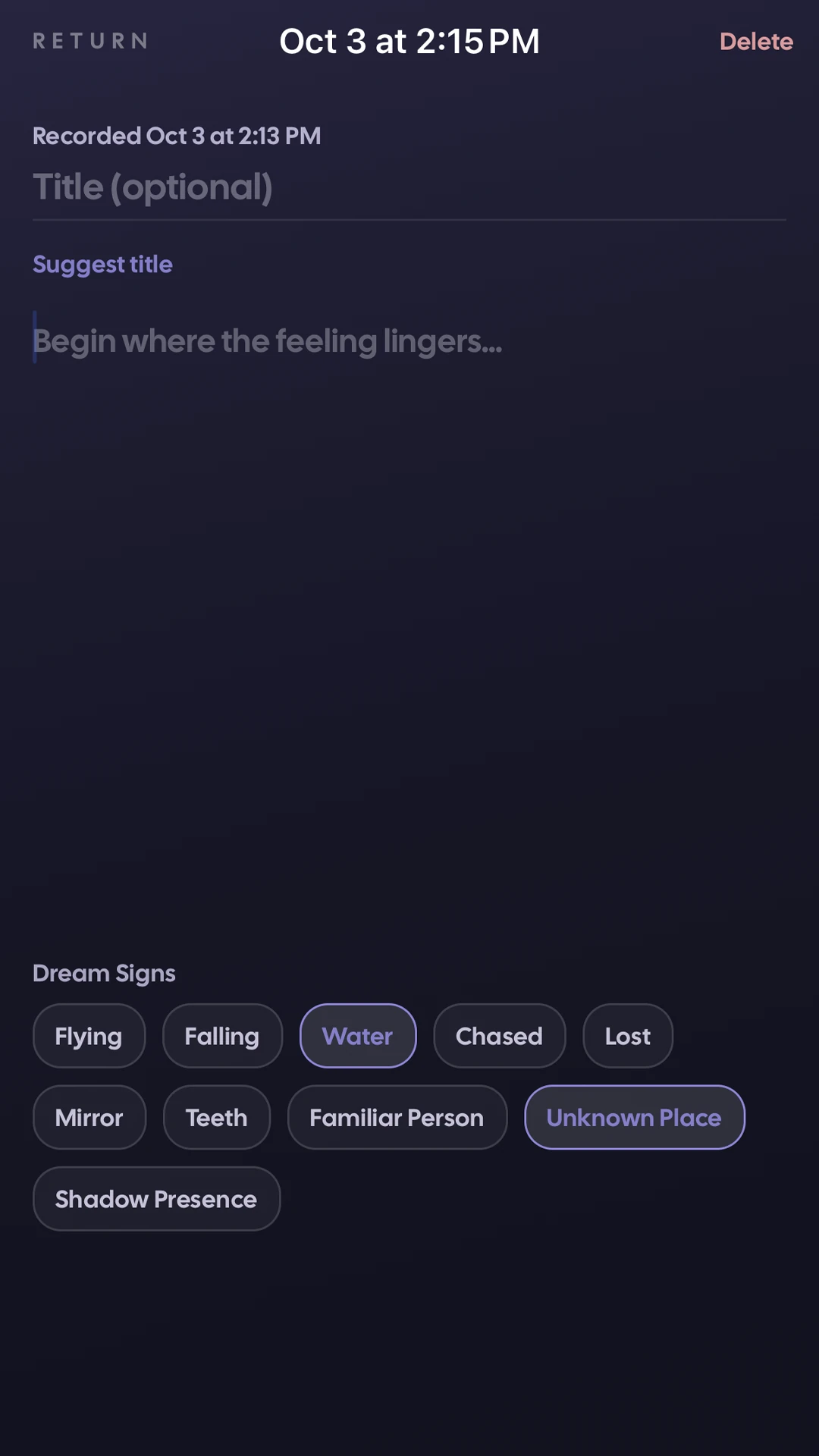
04 When Little Remains
Some mornings bring almost nothing.
Some mornings bring only a mood, a color, a name, or the sense that something happened. Write that. Record fragments before deciding that you did not dream.
A single line keeps the practice going. Do not strain after the rest. If nothing more comes, let it go for the day and try again tomorrow. You decide what is worth keeping.
05 Patterns
What repeats becomes visible.
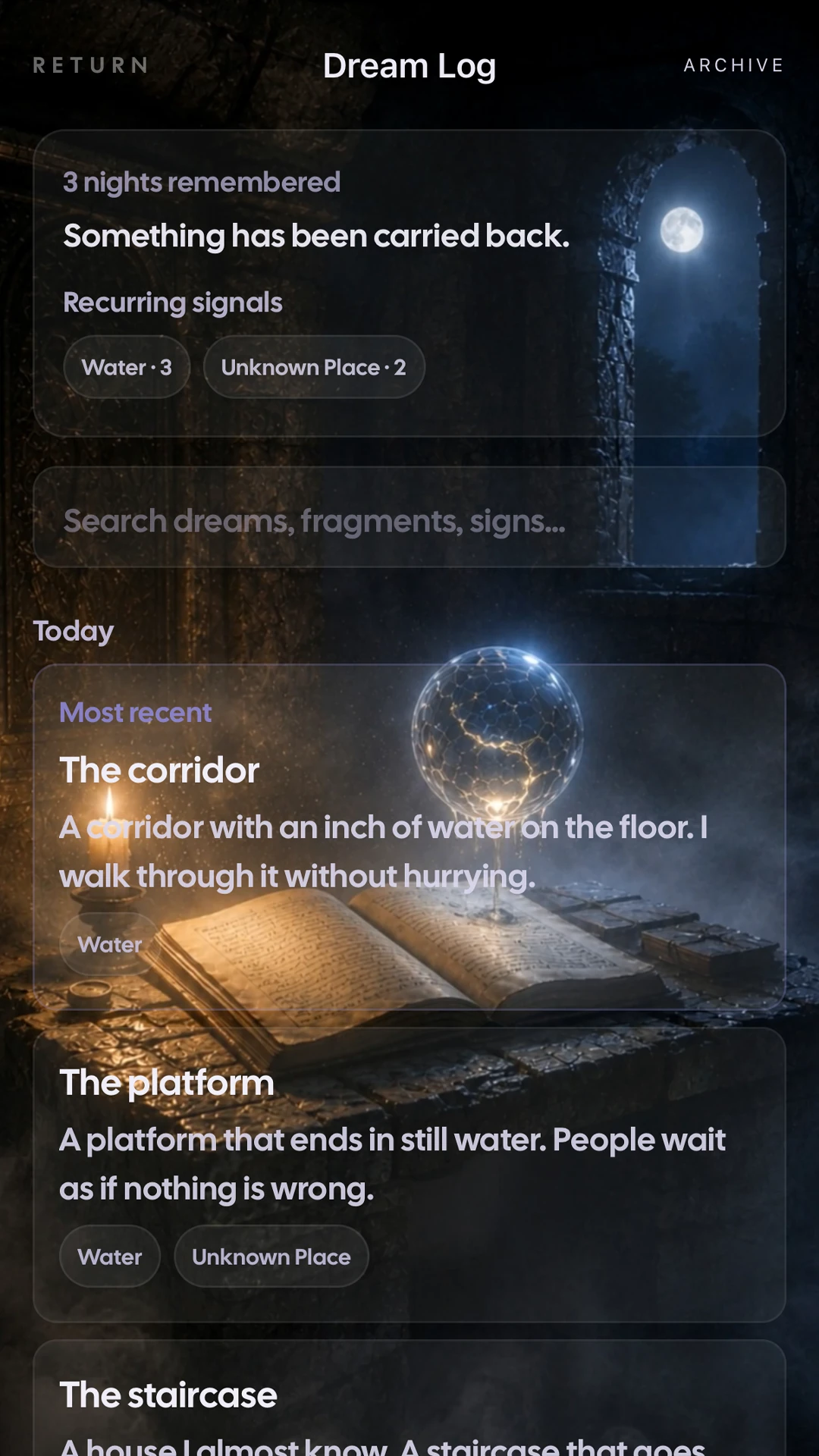
Over days, entries begin to echo one another. Recall reveals your dream signs—the repeating material that makes your dreams recognizable. Look for recurring places, people, emotions, and impossibilities.
A pattern does not have to be dramatic. A kind of light, a type of room, a feeling of being late—anything that returns counts. Collect before you conclude: wait until something has appeared more than once.
To look, read several entries in a row and underline what appears more than once. The words you underline become a short list of your own dream signs.
- Tuesday
The windows show water instead of the street.
- Friday
A platform that ends in still water. People wait as if nothing is wrong.
- Sunday
A corridor with an inch of water on the floor. I walk through it without hurrying.
Water, three times. Noticing comes first. What it means, if anything, is yours to decide.
Many lucid-dreaming practices use patterns like these as personal cues for noticing a dream. The idea is to notice inside the dream what you have already noticed on the page. Research has not established dream-sign cueing as a reliably effective lucid-dream induction method. Recall is also closely associated with lucid dreaming: people who remember their dreams more often tend to report lucid dreams more often.
Continue the practice
In Inner, a dream sign you tag in more than one entry appears with the recurring signals.
06 Looking Back
Look back without grading yourself.
Once a week, read back through what you have written. Notice changes in recall, vividness, and recurring signs. Continue what produced signal. There is no score. A week with one line is a week of practice.
Choose one thing to carry into the coming week: a practice to keep, a sign to watch for, or simply the habit of the page.
- What returned?
- What was new?
- What stayed unfinished?
What remains?

Continue
Keep the page close. Bring something back.
Inner’s Dream Log is one place to keep what you bring back.
The three guides are not levels. Return to any of them, in any order.